BREXIT Watch 2021–05–15

In this issue of Brexit Watch… 🗞️

  • This week
  • News
  • Opinion & Analysis
  • News & views from the EU
  • EU News Blast: vaccines, rights, equalities
  • Stories of Brexit Action Day!
  • Member Briefing: Equality & Citizens’ Rights
  • Farming: How Brexit affects what I eat and what I see
  • Istanbul Convention
  • Catch up: Europe Day 2021

This week 📰

Shocking evidence of abuses suffered by EU citizens emerged this week, as it was reported that some were being detained and deported upon arrival in the UK. One woman, 25, from Spain said she was “still in shock” after being detained for three days following her arrival at Gatwick. Despite rules allowing non-visa holders to attend job interviews in the UK, they are among those being detained in immigration detention centres such as Yarl’s Wood and Colnbrook. Another woman, 24, from Italy was detained without access to her phone or passport. Such abuses by Home Office and Border Force personnel have long been inflicted on non-citizen residents from outside the EU; with the Settled Status application deadline rapidly approaching, EU citizens are beginning to be sucked into the orbit of the government’s ‘hostile environment’ immigration doctrine.

A survey of EU citizens resident in the UK revealed that around half do not trust the UK government to treat them equally, while one in ten are considering leaving the UK. Research by the Independent Monitoring Authority for the Citizens’ Rights Agreements (IMA), set up under the Withdrawal Agreement, showed that significant numbers were concerned about the lack of physical proof of residency status; the IMA is considering legal action over the physical documentation issue. Seven per cent of those spoken to cited the Windrush scandal, with one saying that they feared being treated as “second class” in post-Brexit Britain. This follows news that 320,000 applications for Settled Status have yet to be processed by the Home Office.

UK government minister David Frost returned from a visit to Northern Ireland declaring that the Northern Ireland Protocol of the Withdrawal Agreement was “unsustainable” as it stands. Saying that the UK would “consider all our options”, his intervention raises tensions in ongoing discussions about the implementation of the Withdrawal Agreement and Brexit deal. A joint statement released by negotiators hinted at fundamental disagreements between both sides over the interpretation of each’s obligations to the other in international law. Speaking at a European Movement members’ briefing on Wednesday evening, Head of Campaigns at the3million Luke Piper voiced his concern that the UK would allow this dispute to impact its treatment of EU citizens’ rights, with potentially damaging consequences.

The Incorporated Society of Musicians (ISM) revealed that UK government ministers have made false statements when claiming that visa-free tours of the EU are out of the question for UK musicians. The government has claimed that getting visa-free tours would require a wholesale renegotiation of the Brexit deal, losing ‘control’ of borders in a move that would not be legally binding for EU member states. Each of the government’s claims is shown to be untrue. Deborah Annetts, the ISM’s chief executive, said that the research shows “it is entirely possible for the government to create an agreement” to prevent the UK music sector from disaster, and accused the government of lacking “political will”. The ISM, Musicians’ Union, Equity, and BECTU are among trade unions and other organisations calling for a visa wavier agreement with the EU to address the crisis. The European Movement supported the calls in our recent Stories of Brexit report.


News 🇬🇧 🇪🇺

Visa-free touring possible in 17 EU countries post-Brexit, says Dowden [Evening Standard]

‘False claims’ made by ministers refusing to rescue visa-free music tours of EU, lawyers say [The Independent]

EU citizens arriving in UK being locked up and expelled [The Guardian]

EU nationals in the UK don’t trust government bodies, watchdog says [Politico Europe]

Britain warns EU that Northern Ireland protocol unsustainable [The Guardian]

Thousands of Scots face severe poverty after Brexit and Covid [The Times]

Minister Refuses To Apologise To Shellfish Industry For Post-Brexit Trade Collapse [Politics Home]


Opinion & Analysis 🗣️

The Observer view on Boris Johnson’s role in the fishing row [The Observer editorial]

The deep roots of Labour’s red wall decline [Peter Kellner for the New European]

NEWS AND VIEWS FROM THE EU… 🇪🇺

News: Israeli-Palestinian violence must ‘stop immediately’: EU [EURACTIV]

Views: Women’s rights: Sign and ratify the Istanbul Convention [EU ministers for EURACTIV]


EU News blast: Vaccines, Rights, & Equalities 🫂 🇪🇺 💉 

1

The EU puts the ball in the USA’s court on vaccine patents

The EU further responded to the USA’s new stance on lifting vaccine patents to increase production worldwide, by calling on the Biden administration to flesh out its plans. The reaction from EU members was mixed, but more negative than positive; both the EU and US had previously rejected the idea of a TRIPS (Trade Related Intellectual Property Rights) waiver to remove some intellectual property protections at the World Trade Organization (WTO). Speaking last Saturday, German Chancellor Angela Merkel argued that the EU had exported most of its jabs already and indicated that it expected more exports from the US especially of key vaccine ingredients. French President Emmanuel Macron equally asserted that while debate on the issue was “a very good idea” he remained sceptical that patent waivers would be very effective. The World Health Organization, India and South Africa have all called for a patent waiver. 

2

Poland and Hungary conspire to remove gender equality provisions from social summit

Reuters reported that Poland and Hungary conspired to remove references to “gender equality” in a joint statement of EU member states published on the occasion of the Porto Social Summit, which took place last weekend. An early draft of the statement, seen on Friday 7th May, had contained commitments to “promote gender equality” as part of commitments to uphold social rights. However, the final version omitted to mention this, with EU diplomats briefing that the two countries had lobbied for significantly vaguer wording. The two countries’ national governments make much of promoting ‘traditional’ values on their domestic political scene.

3

A bill to decriminalise abortion is tabled in Malta

On Wednesday, a historic bill was tabled in Malta’s parliament which would decriminalise abortion. Malta is currently the only EU member state with a total ban on abortion, although various states have made well-documented efforts to restrict access to medical abortions in recent years. The bill was submitted by independent MP Marlene Farrugia, who said that “safeguarding women’s rights does not come through the threat of putting them in prison.” The bill will have trouble getting through Malta’s political system, as both major political parties are openly anti-abortion. The governing Labour Party did however offer some indication that the matter could be heard, with Environment Minister saying that their party would be ready to discuss it.Stories of Brexit Action Day!

On Friday 21st May (next Friday!) the European Movement is holding our Stories of Brexit Action Day.

This is your opportunity to make your MP hear the real stories of Brexit – how the Brexit deal has harmed so many from all different spheres of life.Will you tell them about how EU citizens need real support, physical proof of residency, and above all certainty that their rights will be respected? Will you tell them about how important it is that musicians and creatives are able to work around Europe? Will you tell them how important it is that we rejoin the historic Erasmus+ programme for our future?
Whatever you care about – we need you to make your MP listen. This is your chance to sit down with your MP and show how crucial it is that the government takes action now.

Click here to sign up and take part in our Action Day on Friday 21stMay – there is something for everyone!


Member Briefing: Equality & Citizens’ Rights with Equally Ours and the3million

On Wednesday, we were joined by experts and campaigners from Equally Ours, the equalities and rights group, and the3million, a group fighting for the rights of EU citizens in the UK after Brexit for an exclusive members’ briefing.
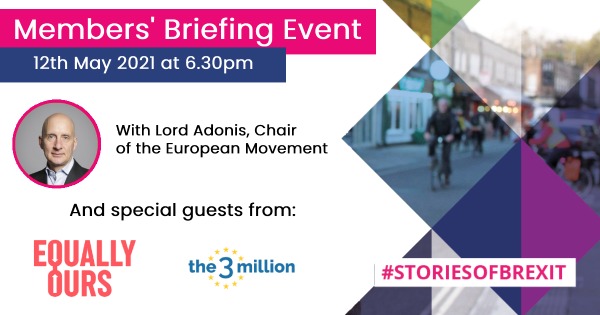
The experts explained why it is so crucial that the government act now to safeguard the rights of EU citizens and make sure that the post-Brexit UK Shared Prosperity Fund addresses social inequalities head on. Click below to watch the event back on YouTube!

Members’ Briefing Event with Equally Ours & the3million – YouTube


Farming: How Brexit affects what I eat and what I see

On Tuesday 18th May at 7pm, East Midlands European Movement is inviting all to a discussion of the impact of Brexit on farming and agriculture.

The question they’ll be asking: is Brexit good for farmers and our food production?

With the lower pound farmers’ incomes are nominally even higher – when they are selling. But come autumn the lower pound will mean higher prices to buy fertilisers, food fodder and seeds.

And where do future bilateral trade deals come into it? How will our food supply shift and change in the months ahead?

To discuss all this, East Midlands European Movement is joined by:

  • Liz Webster, farmer and founder of Save British Farming
  • Andrew Brown, farmer, environmentalist, and former Chair of East Midlands NFU

Click here to attend the meeting on Tuesday 18th May at 7pm!

You can view other upcoming European Movement events by clicking the button below or navigating to our website.


Istanbul Convention at 10

The Istanbul Convention of the Council of Europe – the Council’s convention on the protection and expansion of women’s rights – turned ten years old this week.

It opened for signature on 11th May 2011 in Istanbul, and by 2019 had gained 45 signatories. It has been described as the first legally binding instrument to define and address gender-based violence in international law. It also created an international monitoring body, the Group of Experts on Action against Violence against Women and Domestic Violence (GREVIO), which consists of representatives from signatory nations.

Click the image above to watch a short film on the Istanbul Convention, from the Council of Europe.

Criticism of the Convention has largely come from ultraconservative and nationalist groups, which have attempted to reframe the instrument as something alien to many in parts of Europe. Unfortunately, these allegations have found purchase in many countries, with nations including Slovakia, Bulgaria, Hungary and Poland either withdrawing from the Convention or signalling their desire to do so.

Most recently, in March 2021 Turkey provoked protest among opposition parties, women’s rights groups, and student bodies by indicating it would seek to leave the Convention that bears its name. Shamefully, the UK despite signing the Convention has not ratified it or formally entered it into force.

In the face of these setbacks, we must redouble our efforts to ensure that the Istanbul Convention is respected both in spirit and in effect across Europe, including in the UK.

You can read more about the Istanbul Convention on its tenth anniversary by clicking here.


Catch up: Europe Day 2021

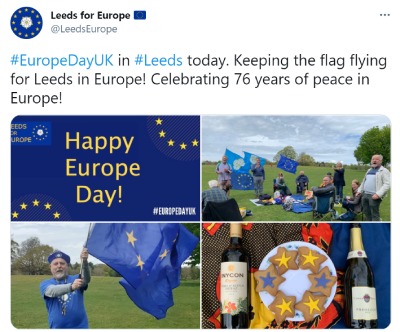
Sunday 9th May was Europe Day 2021 – and loads of our members and activists took the opportunity to celebrate everything the European project has achieved in over 70 years!

Leeds for Europe held a great Europe Day picnic…
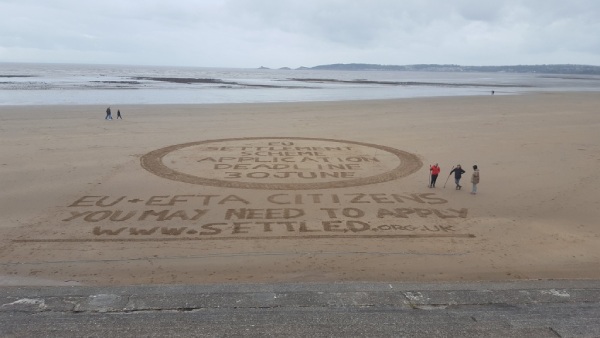
While our friends at Wales for Europe/Cymru Dros Ewrop shared this incredible message from Swansea for EU and EEA residents of the UK…
In addition, we held our livestream event with European Movement International on Monday with thousands of attendees. It featured speakers including Julius Lajtha, President of the Young European Movement, former MEPs Molly Scott Cato and Jude Kirton-Darling, and the Secretary General of European Movement International Petros Fassoulas.

You can watch the event back on Facebook here and on YouTube here for some inspiration!


I hope you enjoyed this week’s briefing… 🌟

…is there something you would quite like to see in future editions?

I’m always looking at other ways to improve this briefing, so let me know what you liked and what I could be doing better.

Best wishes,

Matthew
European Movement UK


Donate


Promoted by Hugo Mann on behalf of European Movement UK, c/o WeWork The Cursitor, 38 Chancery Lane, London, WC2A 1EN

Europe Day Picnic

The sun shone kindly down on the half-dozen members of EMMK who gathered in Cathedral Gardens, Rochester, on Sunday, 9 May 2021 to celebrate Europe Day with a Picnic.

The half-dozen included your Chair, Peter Daws, your Treasurer, Derrick Cripps, and your Chief Brexorcist, Peter Cook.

From L to R: Derrick, Peter C, Nico, Susanne & Peter D (& Ph? took the picture!)
In front: the Picnic bag donated by the European Parliament Office in London

There was a little raffle for a foil-lined picnic rucksack generously donated by the London office of the European Parliament. It was won by Peter D. There was also a prize of a bottle of wine (does anyone know who won it?) and a copy of the CD “You write the Songs” from Sixteen Million Rising, which was won by Derrick. This album features Peter C. and Rage Against The Brexit Machine singing “ ’Allo Vera – Brexit’s Comin’ ’Ome”.

News

From the CEO of EMUK, Anna Bird

I am delighted to announce that Lord Andrew Adonis, is the new Chair of the European Movement.

Lord Adonis becomes Chair at an exciting time for our organisation, in the run up to our ‘Building Bridges, Not Barriers’ conference, which will bring together politicians, high profile campaigners, and thousands of activists at the end of March to forge a path back to Europe together. As the UK is starting to feel the full force of the impact of Boris Johnson’s Brexit deal on our economy and industries – from fishing to financial services, arts to retail – Lord Adonis brings a wealth of experience to help lead our campaign to rebuild our relationship with the rest of Europe, brick by brick.You can read what our new Chair has to say here:

We have also co-opted three new members to the European Movement’s National Executive Committee – former MEPs Molly Scott-Cato and Sajjad Karim, and European Movement activist Jane Thomas, who will join the board in March.


Molly, Saj , and Jane are great new appointments to the National Executive, and bring a wealth of pro-European campaigning experience. They will help us in modernising the European Movement as we seek to build a more diverse, plural movement that better represents our communities and our country.
I hope you will join me in giving a big welcome to Andrew, Molly, Saj, and Jane, and retweet the news of these great appointments: 


Regards, 
Anna Bird
CEO of the European Movement 


P.S. Lord Adonis will give his first address as our new chair at our ‘Building Bridges, Not Barriers’ conference. Get your FREE ticket here:

Have You Felt the Impact of Brexit?

As part of its #BadDeal4Britain campaign the European Movement wants to highlight the local impact of Brexit and are looking for examples of individuals, businesses or communities that have been directly impacted by Brexit. Do you know of any specific examples in your immediate area? 

What would be most useful, are stories of how people, companies and places have been affected.Such as:

  • firms that export and import, hit by the wall of new red tape, leading to increased costs and delays;
  • manufacturers hit by additional paperwork and supply-chain difficulties;
  • hauliers, fishers, farmers, retailers;
  • individuals and companies who are no longer able to provide services in the EU as they do at present;
  • consumers hit with exorbitant new costs to import goods to the UK or send items to the EU;
  • people unable to import products like prescriptions from the EU because of the new rules.

All replies to mid.kent@europeanmovement.co.uk 

Protect Workers’ Rights!

logo

This has to be stopped – hard-won workers’ rights like the 48-hour working week, rest breaks at work and holiday pay entitlements are at risk. On Monday, MPs will vote on protecting these rights from being watered down by the government. Write to your MP today and send a message that our rights are not up for grabs.

Ministers have already admitted employment protections are being reviewed after Brexit. They claim there are no plans to undermine workers’ rights, but why order a review if you don’t intend to change anything?

The European Movement will fight any and all plans to dilute our rights. British workers currently enjoy specific protections:

  • Including overtime in holiday pay calculations, ensuring employees who put in extra hours are not left out of pocket
  • legal cap on the number of hours people can be made to work by their employers
  • The right to rest breaks at work, protecting the safety of key workers

It is time this government killed the rumours and ruled out any change to these vital safeguards for British workers. If you agree with us that these vital rights must be protected, please write to your MP now.

Monday’s vote on workers’ rights is the first since the UK left the EU. MPs must take this opportunity to send a message that a fairer future for all has to include matching or exceeding the protection of workers’ rights that we enjoyed as part of the EU.

The clock is ticking – it’s time to send a message. 

Best Wishes,

Caroline Lucas MP 

P.S. If you’re not yet a member of the European Movement, but would like to help us build a stronger movement and continue the struggle to safeguard our rights, just click below to join today. It starts from just £3.00 per month!

Promoted by Hugo Mann on behalf of European Movement UK, c/o WeWork The Cursitor, 38 Chancery Lane, London, WC2A 1EN

Best for Britain Report says, UK-EU deal ‘Not fit for modern trade environment’

[Copied from Best for Britain]

That’s the verdict of our brand new analysis of the deal. So we’ve avoided a January no-deal, but we’ll need to build a better deal in 2021.

Our report, written by trade expert David Henig, warns that, although the Johnson deal is better than a WTO arrangement, it will still result in ‘considerably higher barriers’ to trade.

Henig identifies many areas of concern, and also points out ways the UK could build on this basic deal with our closest neighbours. You can read the report in full here.

So what now? MPs are voting on the deal on Wednesday 30th December, and we need your help to make sure they’ve read our report before the vote.

Even if you’ve written to your MP before, please get this report to them. We need all MPs to know what they are voting on.

This deal was negotiated at speed, and it shows. It is far from the comprehensive deal voters were promised – it is woefully thin on services that account for the lion’s share of our economic power, and it bears little resemblance to a modern trading agreement.

But the foundations have been laid, and now the serious building work must begin. Our report prioritises the next ten storeys that the UK and EU should layer on top of the deal, to protect our consumers, workers and businesses.

Best for Britain will continue to scrutinise how this deal works in practice. And we will work to persuade the UK government to continue talking and cooperating with our European allies.

We want to see the recommendations in our report become real. This basic deal is just the beginning – we can make a proper modern trading relationship with the EU.

Thanks for your help.

Best wishes,

Naomi Smith,CEO, Best for Britain

International Migrants Day

[This Blog Post is copied from Global Justice Now]

This year many of us in the UK have faced more restrictions on our freedom of movement than we ever imagined we would.

It’s been a tiny insight into what it must be like to be permanently separated from your family and friends – not temporarily to try and stop a deadly disease, but continuously, because of the unfairness of our deadly border system. For many, restrictions on movement have long been a fact of life. And it’s getting worse.  

Under this government, Priti Patel’s Home Office is doubling down on the ‘hostile environment’. Just this week it has announced plans to refuse asylum applications from refugees who have passed through ‘safe’ third countries, in an apparent breach of international law; a former minister has accused the Home Office of planning to house migrants in camps with no access to electricity or healthcare; and we have discovered that 29 asylum seekers have died in government accommodation this year – five times as many as those who died trying to cross the Channel.

When we bear in mind that many of those seeking a better life are leaving behind poverty and conflict which Britain and other rich countries have fuelled through arms sales, toxic trade deals, dodgy debts, land grabs and climate change, the situation seems even more shameful.

Today, on International Migrants Day today, we want to show that there are alternatives. Our new pamphlet: Freedom of Movement: Why we need open borders, aims to summarise the case for global free movement as a long-term demand in the fight for global justice. You can read the introduction, and download the full pamphlet, here:

We can’t deny that global free movement is a very long-term goal. Nor is it the whole answer – we also need to create a much more equal world, stopping those policies which are fuelling forced migration in the first place. But when you look at the increasing violence caused by ever more brutal borders, the inequalities, exploitation and racism that the global border regime entrenches, we believe it is urgent to look for a radical alternative.

It cannot be right that the place you are born dictates whether you will live a life of poverty or plenty, of freedom or imprisonment. It cannot be right that while the richest, at least in normal times, move around with ease, the poorest are imprisoned in geographical poverty.

In the pamphlet we also look at some of the short-term measures that we can push in order to strengthen migrants’ rights here and now, to take us closer towards the goal of free movement. And we look at past and present regional free movement zones which offer concrete examples of how it could work. Finally, we look at a variety of common fears that we need to understand and respond to as part of making the arguments for free movement.

Freedom of Movement is our small contribution to injecting hope and energy into a debate which often sees those championing migrants rights pushed onto the back foot. After all, really big changes have always come about when those campaigning and organising have been ‘unrealistic’ in what they’re calling for; when we have demanded the impossible.

It is only by starting to free our imaginations that can we begin to really see how things could be otherwise. This year has shown us that more than ever.

In solidarity,
Nick Dearden
Director, Global Justice Now

Small Tail Wags Large Dog

With just over two months until the UK cuts the final ties that bind it to the EU, we still don’t have any kind of trade deal. In spite of the government’s blandishments about WTO rules and an “Australian-type” deal, reasons for anxiety continue to grow. What enrages in particular is the obstacle that is the British fishing industry. The briefest look at the numbers reveals that it is the stump of a tail effectively wagging a very large dog.

The figures are fascinating, not least because it shows British fishing willing to cut off the UK’s nose to spite its face. Fishing contributes about one eighth of one per cent (0,12%) to the gross domestic product of the UK, and yet is holding the UK and its economy to ransom. The current workforce of below 24 000 represents less than 1% of the national workforce of around 33 million. Our nation consumes an enormous weight of cod, yet about 83% has to be imported. In all, Britain buys in around 70% of what it consumes, and sells off about 80% of what it catches.

British fishermen catch large numbers of shellfish, 80% of which is sold into the single market, largely France and Spain. This represents around £ 430 000 000 per annum, or about a quarter by value of all fish sold. It appears that under WTO rules selling seafood into the European single market attracts a tariff which could be as high as 24%, or £ 103 200 000.

Will our fish exporters be in a position to absorb the additional cost of their goods to continental consumers, or can our government guarantee that continental fish-lovers will be willing to cough up the extra? All we can do for now is wait and see. But I’m not holding my breath.

How to Lose Your Head!

One has to be so careful nowadays. The wrong word, or a word missing or a word too many, and you could be facing catastrophe, or worse!

In short, Nico has resigned as Chair of the Mid Kent branch, partly because of unclear wording in our constitution. A request for a Special Meeting required “five members or 10% of the membership”. The intention, clearly, was that the request should be made by 10% of the current membership, with a minimum of five, whichever is the greater. The general interpretation, however, is that five requests are all that is necessary in all circumstances.

In the current covid-ridden circumstances it was deemed to be in no one’s interest to try and convene an Extraordinary General Meeting to settle the matter, hence Nico’s decision to tender his resignation with instant effect.

The situation is made all the more confusing by the fact that the constitution defines membership so widely, that practically everyone in Kent could declare themselves a member of MidKent4EU! Still only five of them would be necessary to call an EGM.

For now, therefore, Peter Daws, the Vice-Chair, becomes acting Chair, and we wish him all good as he shoulders this burden. Arrangements will need to be made for elections at some stage, maybe at the next Annual General Meeting. Certainly at the next AGM there need to be proposals for amendments to the constitution, to plug the visible holes and to remedy some of the vagueness.

Begum, Come Back!

A recent edition of Radio 4’s “Any Questions” was asked to say whether or not Shamima Begum should be permitted to return to England to appeal in person against the removal of her british citizenship. This may not seem, at first sight, to relate to the UK’s membership of the European Union, but it does go straight to the heart of the kind of country we claim to be. Membership of the EU does the same.

For all that we claim to be a secular and diverse society, the values which we vaunt as british, and are shared by our continental kin, are rooted deep in the teaching of the christian scriptures. As I listened to the panel giving their views, I kept hearing the voice of a teacher from Galilee, as he spoke to those who came to hear him. Someone asked him, “Who is my neighbor?” He told the story of a man who was violently robbed and left for dead. Those of his own community shunned his apparent corpse, but a despised outsider shewed pity and arranged for his care out of his own pocket. It turns out that our neighbor is not necessarily among our kith and kin, but may be a despised foreigner.

There are reasons to believe that Miss Begum is undesirable as a citizen of the United kingdom, but there is no reason to withhold justice from her, just because she’s different. It’s one of the qualities—justice, fair play—which we claim as being truly british. If we do not allow her to have her day in court, we shew ourselves to be as callous as she appears to be. The way to spread our values can never be to lower ourselves to the level of those for whom we have contempt, but to seize the higher, more humane ground. To try to be “Good Neighbors”, even to those whom we fear.

Nico